2025年11月1日土曜日

VERGE 25参加レポート:データセンターのサステナビリティ課題を企業が「逆ピッチ」

VERGE 25で「Corporate Reverse Pitch for Data Centers: What Climate Leaders Need Built Now(データセンター:気候リーダーが今求めるソリューション)」というセッションに参加しました。

このセッションの面白いところは、通常のスタートアップが企業にピッチする形式ではなく、企業のリーダーたちが起業家や投資家に向けて自社のサステナビリティ課題をピッチするという「逆ピッチ」形式だったことです。

パネリストが提示した主な課題

HPE(Monica Bachelder氏、Chief Sustainability Officer)

  • クリーンエネルギーの可視化 - サーバーやワークロードレベルでの再生可能エネルギー利用状況の把握と最適化
  • ソフトウェア効率性の測定 - AIモデルが実際にどれだけのコンピューティングリソースを消費しているかの測定
  • 人材育成プログラム - AIとサステナビリティの両方を理解できる人材の育成

Amazon Devices(Juliette Devaney氏)

  • プリント基板の革新 - アディティブ・マニュファクチャリング(積層造形)によるプリント基板ソリューション
  • 低炭素材料 - デバイス部品への低炭素材料の活用
  • エネルギー効率 - 熱管理、ディスプレイ、バッテリーにわたるエネルギー効率の向上

Equinix(Greg Metcalf氏)

  • 熱回収システム - データセンターの廃熱を地域暖房に供給するシステム
  • スペースと都市統合 - 限られた空間での熱回収システムの実装と都市環境への統合
  • 経済性の課題 - 米国では天然ガス価格が低いため、熱回収の経済的メリットが出にくい問題の克服

National Grid Partners(Aaron Panzer氏)

  • フレキシブル接続ソリューション - 年間5%のピーク需要期間に対応するための柔軟な電力接続
  • 運用ツール - 電力網上の変動負荷を管理するための運用ツール
  • モバイル/バッテリーソリューション - より迅速な相互接続を実現するためのモバイル・バッテリーソリューション
  • 長期インフラ計画システム - 長期的なインフラ計画を支援するシステム

スタートアップとの協業方法

各社は、スタートアップとの協業方法についても共有してくれました。パイロットプログラムや共同イノベーション、VC投資、そしてentrepreneur-in-residence(社内起業家)プログラムまで、多様な協業の形があることがわかりました。

所感

解決すべき具体的な課題が明確に示されたことで、起業家や投資家にとって非常に有益なセッションでした。今後もこのようなセッションが増えてくると面白いなと思います。

2022年2月9日水曜日

VC firms started to look their own figure through the ESG/sustainability mirror

Several well-known Venture Capital firms have recently started publishing their sustainability reports. 

In a previous article, I wrote that the characteristics and strengths of companies can be identified by reading sustainability reports and analyzing sustainability data. This is even more true for VC firms. For VCs, there is no standardization for ESG/sustainability data disclosure, so they decide for themselves what data to disclose and design the sustainability report more freely than companies whose shares are publicly traded.


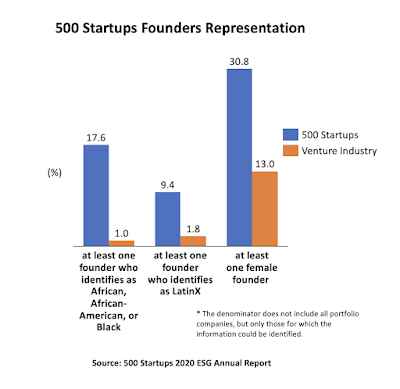
I recently read a sustainability report from 500 Startups. Since they have accelerator programs in several countries and invest in startups globally, they proudly report on the diversity of their portfolio company founders. According to the ESG report, 30.8% of their portfolio companies have at least one female founder (the industry average is 13%), 17.6% of portfolio companies have at least one Black/African/African-American founder (the industry average is 1.0%).

Another impressive sustainability report I read was from Energy Impact Partners.


The report comprises 73 pages and contains a large amount of detailed data on the portfolio companies. Not only aggregated figures are disclosed, but also the raw data of the individual portfolio companies. One of the data that I found interesting was the turnover rates (the average total turnover rates of the portfolio companies was 23%) - by looking details of the turnover rates, I could see the impact of COVID-19 on the startups. 


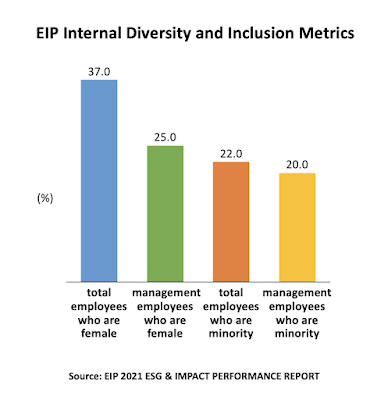
What stands out from others is that Energy Impact Partners also discloses their own organization's carbon footprint and diversity metrics. I think that's very progressive. According to the report, the percentage of female employees at EIP is 37%.


There is often criticism that the VC industry lacks diversity (lack of gender, racial diversity etc.). With the publication of sustainability reports, VC firms have started to look not only at the sustainability and impact of their portfolio companies, but also at their own sustainability, and I think that's a great thing for the industry as well.

2021年4月15日木曜日

How to prioritize sustainability initiatives - examples of materiality matrix

There are many ESG initiatives that seem so important to companies, but corporate resources are limited, so trade-offs often have to be made. Balancing long-term environmental and social impacts with short-term profits is one of the biggest challenges for companies. Another example I've seen in conversations with companies was the reduction of Scope 3 GHG emissions versus supplier benefits. One of the ways to prioritize these ESG initiatives is to assess materiality. For reference, I have put together some examples of the materiality matrix from recent corporate sustainability reports. I found that Altria, a tobacco company, has done this materiality assessment on a large scale. They surveyed 9500 people who are stakeholders, such as employees, consumers, growers, suppliers, trading partners, government officials, communities, NGOs, etc. They spend 4 pages explaining the methodology in their sustainability report. If you look at GM's materiality matrix, it says that developing the electric vehicle market is most important, and they use the matrix to support their corporate strategy, which focuses on electric mobility and sends clear messages to readers. Conducting a materiality analysis and communicating about it in sustainability reports becomes very important.


1, Altria 2020 Materiality Matrix


Source: Altria Engage and Lead Responsibility: 2020 - 2021 (P.14) 


2, GM 2019 Materiality Matrix

 Source: GM 2019 Sustainability Report (P.32)


3, PG&E Materiality Matrix (2017)


4, American Express Materiality Matrix


5, eBay Materiality Matrix

Source: eBay Impact 2019 Report  (P.7)

2021年2月5日金曜日

How environment friendly are the auto makers ? (comparison of sustainability data)

President Biden recommitted the United States to the Paris climate agreement. "Green New Deal"-type stimulus to recover from COVID-19 is being considered not only in the U.S., but also in many other places around the world. As environmental awareness increases, it appears that corporate efforts to reduce greenhouse gas emissions will accelerate in the coming years. 


This time, I compare automobile companies because GHG emissions from the transportation sector are significant and automobile manufacturers play an important role in this. 


First, I compared GHG emissions data from three automakers, Toyota, Volkswagen, and GM, that have disclosed detailed GHG emissions data in their environmental reports. (I also checked Daimler, Ford, and Tesla, but I could not find specific Scope 3 GHG emissions data in their sustainability reports.)


  • Scope 1 emissions - direct emissions including on-site fuel combustion
  • Scope 2 emissions - indirect emissions such as purchased electricity, heat and steam. 
  • Scope 3 emissions - all other indirect emissions from their value chain, including the purchase of materials and parts, use of sold products etc. 

Scope 1 and Scope 2 emissions are emissions from corporate activities. Compared to Scope 1 and 2, Scope 3 emissions are difficult to calculate but very important to capture the carbon footprint.
 
Looking at the CO2 emissions intensity (Scope 1 emissions + Scope 2 emissions per vehicle), the comparison is as follows.

Toyota has a much lower level of Scope 1 emissions compared to other companies. According to its environmental report, this is achieved by introducing innovative technologies and promoting energy savings through daily kaizen. The company plans to achieve zero CO2 emissions at its global plants by 2050.

In terms of water consumption per unit, Toyota's figure seems slightly better. 


When it comes to the use of renewable energies, Volkswagen is ahead of the game. They already achieved 41% renewable energy in their electricity consumption, while Toyota and GM achieved 12% and 22% respectively.

We can see the strengths of each company by comparing their environmental data. For example, Toyota seems to be good at saving energy and improving energy efficiency, and Volkswagen seems to be good at utilizng renewable energy. 

In the future, we can expect the amount of data disclosed in environmental reports to increase. By comparing different KPIs, we may continue to identify companies' characteristics and strengths.

Source:
https://global.toyota/pages/global_toyota/sustainability/report/er/er20_en.pdf
https://www.volkswagenag.com/presence/nachhaltigkeit/documents/sustainability-report/2019/Nonfinancial_Report_2019_e.pdf
https://www.gmsustainability.com/_pdf/resources-and-downloads/GM_2019_SR.pdf
https://www.tesla.com/ns_videos/2019-tesla-impact-report.pdf
https://global.toyota/en/company/profile/production-sales-figures/201912.html

2021年1月27日水曜日

How environment friendly are the GAFA companies? (Comparison of Renewable Energy)


It seems that GAFA investments in renewable energy will continue to grow in the coming years.


Recently I had the opportunity to look at the ESG reports of GAFA companies (Google, Apple, Facebook, Amazon) and found some interesting facts by comparing numbers. 


First, I compared the percentage of renewable energy in their electricity consumption. Google and Apple achieved a rate of 100% renewable energy on their electricity consumption in 2019. Facebook and Amazon reached 86% and 42% respectively.


Amazon's share of renewable energy in electricity consumption is significantly lower than other companies. Amazon has set a goal to use "100% renewable energy" by 2025, so major investments in renewable energy are expected in the coming years. 

Comparing contracted renewable capacity, it appears that Google maintains its lead, although Facebook added 1.7 GW of contracts in 2019. (Edit: Amazon revised its sustainability report and claims they have 6500MW of solar and wind projects as of Dec 2020.)

Because Apple does not manufacture products in its own facilities, the amount of renewable energy used in Apple's own facilities is relatively small. According to Apple's report, 75% of its carbon footprint comes from product manufacturing. Therefore, Apple introduced the Supplier Clean Energy Program in 2015, and now the renewable energy capacity at Apple suppliers is significant. Apple recently set a more ambitious goal to "transition our entire manufacturing supply chain to 100 percent renewable power by 2030," so renewable energy investment at Apple suppliers is expected to continue growing.

Since 2010, Google has invested "nearly $2.7 billion in large-scale renewable energy projects with an expected total combined capacity of approximately 4.6 GW". (The figure excludes Power Purchase Agreements for their operation.) 

I also looked at the time series data of Google's renewable electricity purchased and found that it grew rapidly over the 2013-2018 period.

As Google's electricity consumption is expected to continue to increase in the coming years, Google's investment in renewable energy is also expected to increase.
  
The installation of EV charging ports at Google also increased at a fast pace. 

Google employees can charge electric vehicles for free as part of their benefits, which has helped reduce greenhouse gas emissions from commuting. Google has installed 2,722 EV charging ports at its U.S. offices through 2018, and Apple has installed more than 2,300 EV charging stations through 2019. 

Speaking of electric vehicles, Amazon announced that it has ordered 100,000 new electric delivery vehicles from Rivian, a U.S. electric vehicle manufacturer, in September 2019. (Amazon led a $700 million round of investment in Rivian in February 2019.)

Although these companies have different business models, they are aggressively committing to reducing GHG emissions and are very good at disclosing the information in their environmental reports. 

Source:
https://rebuyers.org/blog/reba-announces-top-10-u-s-large-energy-buyers-in-2020-2/
https://sustainability.aboutamazon.com/pdfBuilderDownload?name=sustainability-all-in-december-2020

2020年12月16日水曜日

COVID19で2020年は二酸化炭素排出量が記録的に減少

12月11日に GCP (Global Carbon project)が出した最新の論文によると、COVID19の影響で2020年には世界の化石燃料由来のCO2排出量が24億トン減少し全体で約34 Gtとなり、2019年に比べて7パーセントの減少となったそうです。


この減少量は、世界の道路から500万台の自動車を削減したのと同等量とのことです。排出量の減少は特に交通分野で顕著で、道路交通と航空交通分野での排出量は、世界全体で2019年と比較してそれぞれ約10%、40%の減少。また、ロックダウンのピーク時には自動車の走行を含む地上交通からの排出量は、約半分に減少しました。


このベイエリアでも、3月にロックダウンが始まってからはそれまでの朝・夕方の交通ラッシュが嘘のように、高速道路が空いています。1日中渋滞していることで有名だったロサンゼルス市も、ロックダウン中は車が著しく減少しているそうです。


排出量の減少が顕著だったのは米国(12%減)とEU27カ国(11%減)。一方、中国では1.7%の減少に留まったとのこと。またイギリスでは13%減少、インドでは9%の減少が見込まれています。


ちょうど米国では来年からバイデン大統領が就任、そして欧州でのグリーンニューディールや市のレベルでのグリーン・ニューディールの広がりもあることから、COVID-19からの経済回復と共に、引き続き排出量の削減、が多くの地域で目指されることになるでしょう。

2020年11月25日水曜日

ロサンゼルス市のグリーンニューディールとスマートシティ・ネットワーク

 先日、スタンフォード大学主催のエネルギーセミナーで、ロサンゼルス市のグリーンニューディールについての話がありました。興味深い内容でしたので、簡単に内容を纏めておきます。


ロサンゼルス市は電力、ビル、交通、廃棄物、水の5つの分野で積極的な目標を定めています。2045年までに電力を100%再生可能エネルギーに、そして2050年までに全てのビルでNet-zero Carbonを実現&市内の車の全てをZero Emission Vehicleに、と非常にアグレッシブな目標を掲げています。


また、これらの目標の実現を通じて、2035年までに30万の雇用、2050年までに40万の雇用を生み出すとしています。


以前から力を入れている港のグリーン化にも引き続き力を入れていく予定で、トラクターやトラックの電動化を進めていきます。


特に面白いと思ったのは、アメリカや世界においてグリーン政策を推し進める市長ネットワークの存在です。「Climate Mayors」というネットワークでは米国の48の州から468の市長が参加していて情報共有をしており、また、「C40 Cities」には世界の97の大都市が参加して、グローバルなグリーンニューディールに向けた議論・取り組みを行なっているとのことです。


スマートシティを推進する市がネットワークを構築し、良い活動を他の市も取り入れていくことで、取り組みが世界に広がっていく。その動きは今後、益々加速していきそうです。